Türkçe
 September 19, 2026

mesaj bırakın
Ürünlerimizle ilgileniyorsanız ve daha fazla ayrıntı öğrenmek istiyorsanız, lütfen buraya bir mesaj bırakın, en kısa sürede size cevap vereceğiz.


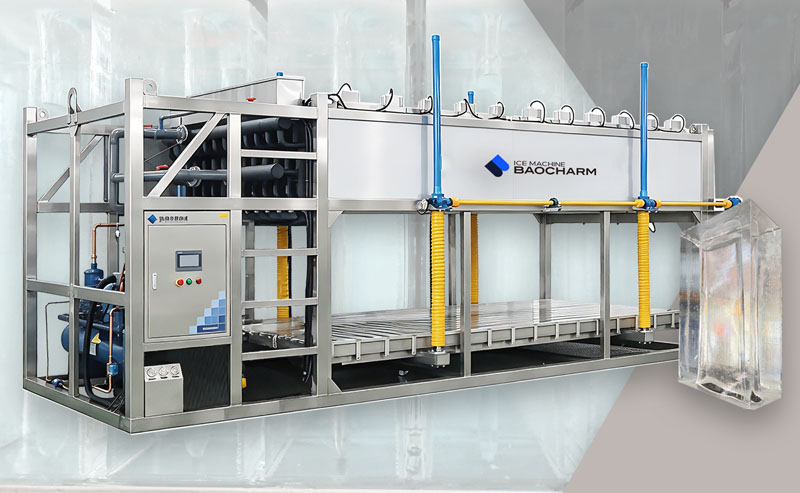
A standard block ice machine freezes from several faces at once and traps dissolved air in the center, which is why the ice turns cloudy. A clear ice block machine freezes from one direction and uses flowing water to carry bubbles and impurities away — so the ice stays transparent, but the cycle takes substantially longer.
In a brine or standard direct cooling block ice machine, cold reaches the mold from multiple sides. Ice closes in from the edges, and the last water to freeze sits in the middle, together with the air and minerals that were pushed there. That center becomes the white core.
A clear ice machine changes the geometry of freezing. The evaporator sits on one face of the mold, usually the bottom. The freezing front moves upward in a single direction, pushing air and impurities ahead of it into the remaining liquid. Water flow then carries that concentrated liquid away before the block solidifies.
Figure 1: Directional freezing vs multi-side freezing — one freezing front pushes bubbles out; five fronts trap them in the center.
Transparency is a process outcome, not a compressor specification. A larger compressor does not make clearer ice. It makes faster ice, which is the opposite of what clear ice requires.
Refrigerant expands directly inside the evaporator plate that holds the ice mold, so heat is removed at the mold surface without a brine loop. The machine then uses slow, directional freezing, controlled water flow, and hot gas defrost to produce and release a transparent block.
The system has four working parts:
The compressor is typically Bitzer, with Refcomp and Hanbell available as options. R404A and R507 are both used. Electrical configuration is customized to the destination market.
Both are clear ice produced on the same direct cooling platform; the difference is the mold. A center-hole block has a through-hole along the long axis, which shortens the freezing cycle but removes volume that would otherwise become saleable ice after cutting.
| Selection factor | Solid clear ice block | Center-hole clear ice block |
| Block form | Solid throughout | Through-hole along the long axis |
| Standard block weight | Approx. 50 kg | Lower than a solid block of the same dimensions |
| Unit ice density | Baseline | 0.1%–0.15% difference per unit volume |
| Freezing time per 3-ton batch | Approx. 44 hours | Approx. 22 hours |
| Holding time | Approx. 2 hours | Approx. 2 hours |
| Blocks per 3-ton batch | Approx. 64 | Depends on mold configuration |
| Transparency standard | No white core, no bubbles, no cracks | Same standard |
| Main trade-off | Longer cycle, higher usable yield | Shorter cycle, lower usable yield after cutting |
The 0.1%–0.15% figure refers to unit ice density, not to the weight lost to the hole. The weight lost depends on hole diameter and block dimensions and is stated separately.
Usable yield is the row most often misread in the comparison table. Large clear blocks ice are usually cut into smaller pieces before use — cubes, spheres, Collins spears. A center hole removes volume that would otherwise become part of those cut pieces. So the shorter 22-hour cycle does not automatically mean better economics. It depends on the cutting plan.
Figure 2: Solid vs center-hole block cross-section — the hole shortens the freezing path but reduces cut yield.
If you are comparing solid and center-hole batches for a specific cutting plan, send us the target piece size and batch capacity. BAOCHARM will reply with the usable-yield comparison for your cutting plan.
Clear ice machines should be specified by batch capacity, freezing time, and holding time — not by a single “tons per day” number. The daily figure depends on how batches are scheduled, and clear ice cycles are long enough that the difference between solid and center-hole changes the production plan.
A buyer compares a “3-ton machine” and a “6-ton machine” as if both produce that amount every 24 hours. For clear ice, they do not.
BAOCHARM’s BCTM-3T and BCTM-6T are different capacity models, both configurable for solid or center-hole blocks. The 6-ton model uses additional molds to complete a 6-ton batch in a comparable timeframe, rather than extending the freezing cycle proportionally. The practical questions are:
A supplier who quotes only a daily tonnage without stating freezing time, holding time, and block type has not given you enough to plan production.
Clear ice blocks serve bars and restaurants that specify clear ice, ice sculpture, seafood display and preservation, and distributors supplying hotels and event venues. The right block type and batch size depend on whether the buyer cuts the ice in-house or resells full blocks.
The most visible use is in bars and venues that specify clear ice, where blocks are cut into large cubes, spheres, and Collins spears. Ice sculpture is the second: internal cracks and white cores become obvious once the block is carved, so transparency is a working requirement rather than a cosmetic one.
Seafood display and short-term preservation use clear ice where appearance and hygiene both matter, and the absence of brine contact is an advantage in food-contact settings. Distributors supplying hotels, bars, and events need consistent batch output more than they need a single large block.
BAOCHARM has delivered clear ice block machines to customers in Indonesia, with a delivery to Brazil in progress. These projects cover bar and restaurant use as well as distributor supply.
Q: Is a direct cooling clear ice block machine the same as a standard block ice machine?
A: No. Both use direct cooling, but a clear ice machine is built around directional freezing and flowing water. The freezing cycle is longer by design, and the machine is configured for transparency rather than maximum output per hour.
Q: How long does a clear ice block take to freeze?
A: It depends on block type and batch capacity. As a reference, BAOCHARM’s 3-ton batch takes about 22 hours of freezing for center-hole blocks and about 44 hours for solid blocks, plus about 2 hours of holding in both cases.
Q: Does the center hole make the ice less clear?
A: No. Center-hole blocks must meet the same visual standard: no white core, no bubbles, no cracks. The difference is the freezing cycle and the usable yield after cutting.
Q: Can one machine produce both solid and center-hole blocks?
A: Yes. BAOCHARM’s BCTM-3T and BCTM-6T are different capacity models, and both can be configured for either block type depending on the customer’s requirement.
Q: What compressor and refrigerant are used?
A: Bitzer is the standard compressor, with Refcomp and Hanbell available as options. R404A and R507 are available, and electrical configuration is customized to the destination market.
Q: Can you provide a freeze-cycle test report?
A: BAOCHARM does not issue a standardized freeze-cycle test report. Transparency is verified visually against the acceptance standard, and project references can be discussed during the inquiry.
The definition is settled; the process is where the real decisions live.
The freezing process is covered next.


İletişim Bilgilerimiz
E-posta: sales@baocharm.com
WhatsApp: +86 17663537579
Wechat: +86 17663537579
Çalışma Saatleri: Pazartesi ~ Cumartesi 08:30 - 17:30
 IPv6 ağı destekleniyor