Türkçe
 September 19, 2026

mesaj bırakın
Ürünlerimizle ilgileniyorsanız ve daha fazla ayrıntı öğrenmek istiyorsanız, lütfen buraya bir mesaj bırakın, en kısa sürede size cevap vereceğiz.


Flake ice is used in chemical and pharmaceutical reactors because it delivers latent cooling instantly and controllably into the reaction mass. When flake ice enters a liquid reactor, it melts and absorbs approximately 334 kJ per kilogram through latent heat of fusion, dropping the solution temperature within seconds rather than minutes. This response speed matters in exothermic reactions — diazotization, coupling, condensation, nitration — where heat is generated faster than a jacket or coil alone can remove it.
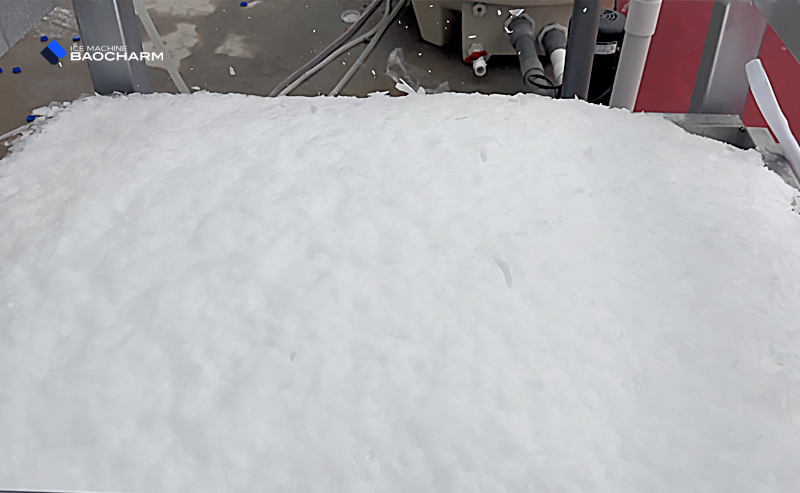
Many chemical and dye processes involve strongly exothermic steps. Diazotization, coupling and condensation reactions release heat that must be removed in time to maintain product quality and prevent runaway conditions. In dye and pigment manufacturing, temperature control is critical: excessive heat or prolonged exposure to elevated temperature can degrade color quality, and pressure buildup during diazotization raises safety concerns.
A reactor jacket or coil removes heat through a surface. When the reaction generates heat faster than the surface can transfer it, the reaction mass temperature rises. Flake ice changes the geometry of heat removal: it is added directly to the mass, melts, and absorbs latent heat at the point where the heat is being generated. The response is not limited by the jacket’s heat-transfer area.
Flake ice has three properties that matter in reactor cooling.
Latent heat per kilogram. One kilogram of ice absorbs approximately 334 kJ as it melts — roughly 80 calories per gram. This is cooling energy delivered as phase change, not as sensible heating of a liquid coolant.
Immediate response. When flake ice is dropped into a liquid reactor, it melts rapidly because of its high surface area. The temperature drop begins within seconds, which gives the operator a fast control lever during a timed exothermic step.
Ice feed without carry-over water. Flake ice can be delivered without carry-over water, so the latent cooling capacity is fully available to the reaction mass rather than being partly consumed by warming the associated water. In processes where adding water is acceptable or desirable, this is not a disadvantage; in processes where water balance matters, it is a control advantage.
| Reaction type | Cooling challenge | Why flake ice | Configuration focus |
| Diazotization | Rapid heat release; pressure buildup risk | Instant latent cooling; controllable addition | Feed rate control; temperature monitoring |
| Coupling / condensation | Heat removal during timed step | Fast response; melts in the mass | Wetted material compatibility |
| Nitration | Strongly exothermic; temperature-sensitive | High latent heat per kg; direct contact | Electrical classification; material grade |
| Dye / pigment synthesis | Color quality sensitive to temperature overshoot | Rapid temperature drop; direct ice cooling | SUS316 where corrosive; hygienic feed |
Process examples are illustrative. Actual configuration depends on reaction chemistry, reactor design and site safety requirements.
The wetted parts of the ice machine and feed system must be compatible with the process environment. SUS304 is the food-grade baseline; SUS316 is specified where the ice or meltwater contacts corrosive chemicals or where chloride exposure is expected.
Electrical classification is a separate decision. Where the ice machine or feed system is installed in a hazardous area, explosion-proof or appropriately rated electricals are required. This should be stated at the enquiry stage; it is not a standard assumption for a food-duty machine.
Feed method also matters. Some reactors receive flake ice through a sealed or enclosed delivery system to prevent contamination; others use a manual or semi-automated feed. The right choice depends on the process hygiene requirement and the operator’s handling procedures.
| Environment | Electrical option | Wetted material option | Note |
| General chemical duty | Standard industrial electricals | SUS304 or SUS316 | Confirm compatibility with process chemicals |
| Corrosive chemical exposure | Sealed / corrosion-resistant electricals | SUS316 | Material review against chemical list |
| Hazardous area installation | Explosion-proof or appropriately rated | SUS316 where specified | Classification determined by site assessment |
Configuration options are subject to project-specific safety and compatibility review. This table is not a certification statement.
A reactor cooling flake ice system is not selected on daily tonnage alone. The relevant questions are:
The machine platform is the same continuous flake ice technology described in How a Flake Ice Machine Works: Vertical Inner-Scraping Evaporator and Ice Blade Explained; the difference is in configuration and feed integration. For processes that also require long-duration cold holding, block ice is a separate option; the comparison is in Flake Ice Machine vs Block Ice Machine: Which Ice Type Fits Industrial Cooling and Preservation?.
Why use flake ice for reactor cooling?
Flake ice absorbs latent heat directly in the reaction mass as it melts — approximately 334 kJ per kilogram. The cooling response begins within seconds and is not limited by the reactor jacket’s heat-transfer area. This makes flake ice a fast, controllable cooling medium for exothermic steps.
Can flake ice be used in pharmaceutical processes?
Yes, with appropriate material and hygiene configuration. SUS304 or SUS316 wetted parts, sealed or enclosed feed arrangements, and compatibility review against the process chemicals are the main considerations. The specific configuration should be reviewed against the process and site requirements.
What capacity is needed for dye production cooling?
Capacity depends on the reaction heat release rate, batch size and cycle time, not on a generic tonnage figure. The useful starting point is the peak heat release per batch or per hour, translated into ice mass using the latent heat of fusion. Feed method and storage also affect the practical capacity requirement.
Book a process cooling consultation. Share your reaction type, batch heat release, feed method and site classification for a configuration review against your process requirements. → Book a consultation


İletişim Bilgilerimiz
E-posta: sales@baocharm.com
WhatsApp: +86 17663537579
Wechat: +86 17663537579
Çalışma Saatleri: Pazartesi ~ Cumartesi 08:30 - 17:30
 IPv6 ağı destekleniyor